
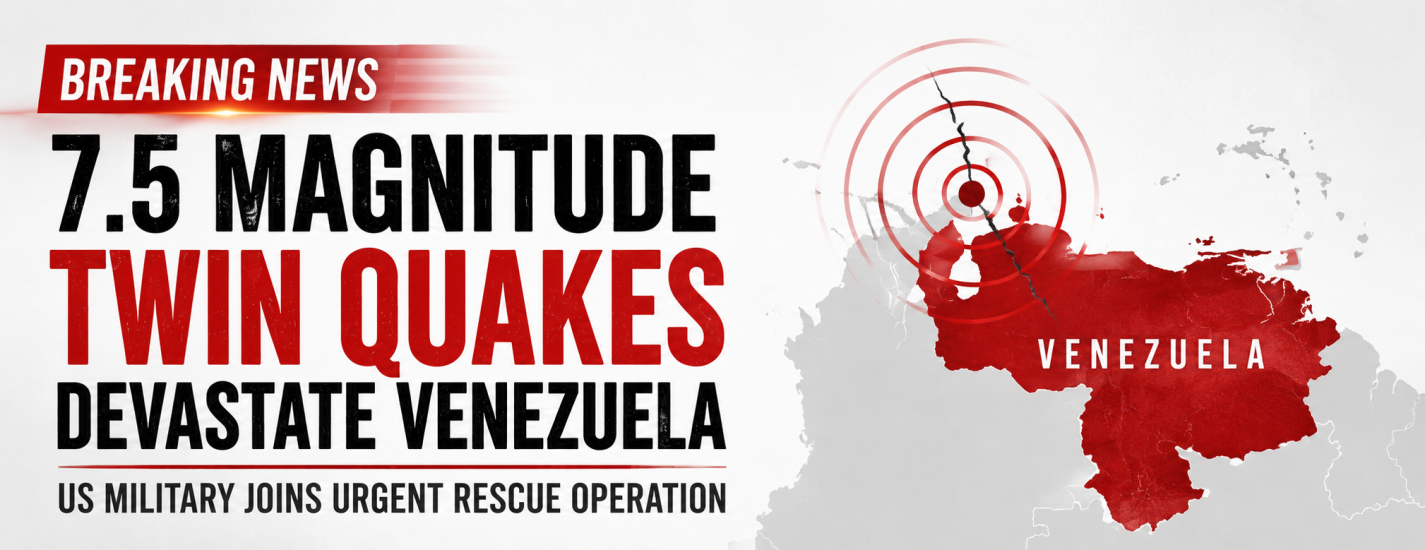

A massive international rescue operation is actively underway across northern Venezuela following a catastrophic pair of twin earthquakes that struck the nation within seconds of each other on Wednesday. Updated reports on Friday, June 26, 2026, confirm that the death toll has soared past 920, with more than 3,360 individuals injured and hundreds still feared trapped beneath the debris. The second of the two tremors registered at a staggering magnitude of 7.5, marking it as one of the most powerful seismic events to hit the South American country in over a century. Emergency crews and civilian volunteers are currently working frantically against the clock to locate survivors before the critical “golden window” for rescue operations officially closes.
Crisis deepens across the hard-hit northern coastline
When the initial assessments concluded on Friday afternoon, National Assembly President Jorge Rodríguez announced the grim scale of the structural devastation. The seismic shocks tore through critical infrastructure, heavily damaging or completely destroying at least 383 buildings, 13 hospitals, 25 shopping centers, and more than 1,000 other essential structures. The coastal state of La Guaira, located just north of the capital city of Caracas, bore the brunt of the destruction. Home to the nation’s primary seaport and the Simón Bolívar International Airport, La Guaira has been placed under full militarization by the government to keep clear the critical transit routes required for medical transport and heavy machinery.
In Caracas, the disaster heavily impacted the prominent neighborhoods of Los Palos Grandes and Altamira, while severe aftershocks—numbering over 214 since Wednesday—continue to rattle the states of Aragua, Carabobo, and Falcón.
Washington and Caracas align amid geopolitical shifts
This unprecedented natural disaster strikes Venezuela during a period of immense political volatility. Less than six months ago, long-time left-wing leader Nicolás Maduro was seized in Caracas during a deadly raid by US special forces and flown to New York to face federal drug-trafficking charges. Maduro’s ally and former vice president, Delcy Rodríguez, subsequently assumed the interim presidency—a move that initially drew sharp criticism from opposition factions who had hoped the Trump administration would back opposition leader María Corina Machado.
However, the immediacy of the humanitarian crisis has prompted unexpected diplomatic coordination. Interim President Delcy Rodríguez confirmed on Friday via her official Telegram account that she had received a direct call from US President Donald Trump and Secretary of State Marco Rubio, both of whom reaffirmed Washington’s logistical and financial commitment to the recovery efforts.
“Following the earthquakes that struck Venezuela on Wednesday, Trump and Rubio reaffirmed their commitment to supporting the response efforts by sending rescuers, specialized equipment, support for temporary shelters, and humanitarian assistance for the affected families. We deeply appreciate this gesture of friendship and cooperation.”
Chronic underfunding cripples the local medical response
While international aid begins to touch down, local medical professionals warn that the country’s pre-existing financial crisis has left surviving healthcare facilities entirely unequipped to manage the sudden influx of trauma patients. Decades of economic instability and underinvestment have resulted in systemic shortages that are severely hampering triage efforts. Speaking directly from an overwhelmed medical center, Dr. Pedro Javier Fernandez highlighted the steep operational challenges facing local doctors:
“All our hospitals lack supplies, lack medicines, we are not able to provide medical attention to our people in a normal day. Now with this tragedy, the emergency is even bigger and it’s more difficult to face than in other countries.”
Jan Egeland, the secretary general of the Norwegian Refugee Council, echoed these concerns after arriving on the ground, pointing out that Venezuela’s “crumbling infrastructure” left the population uniquely vulnerable to an emergency of this magnitude.
A coordinated global mobilization takes flight
In response to a directive from UN Humanitarian Chief Tom Fletcher for an international response, multiple nations have deployed specialized assets directly to the region:
- The United States: Deployed military personnel, transport aircraft, naval warships, and an initial $150 million (£113 million) emergency aid package coordinated via the State and Defense Departments.
- The United Kingdom: Dispatched an RAF military transport flight from Brize Norton carrying search-and-rescue specialists, trained K9 units, and advanced structural drones pulled from 14 British fire services.
- International Teams: Specialized disaster response personnel from the Netherlands, Mexico, and Switzerland have officially integrated into the domestic rescue grid.
Heartbreak and miraculous survival amidst the rubble
As heavy machinery begins the grueling task of clearing heavy concrete blockades, deeply personal tragedies and stories of profound resilience are emerging. The international community has felt the direct impact of the disaster, with foreign ministries confirming the deaths of four Spanish nationals, two Brazilian citizens, and one Portuguese national, while more than 106 Spanish citizens remain completely unaccounted for.
In one widely shared tribute, Venezuelan professional footballer Héctor Bello took to social media to mourn his wife, Andrea, who tragically lost her life while shielding their toddler from a collapsing ceiling during the peak of the tremors. Bello vowed to raise their daughter with the knowledge of her mother’s final, heroic act of bravery.
Conversely, moments of survival have provided vital morale boosts to exhausted rescue crews. State television network broadcasts captured the emotional rescue of three young siblings in La Guaira, who were successfully pulled entirely intact from a narrow pocket beneath collapsed concrete slabs. Elsewhere in the state, families like that of Natacha Diaz continue to keep vigil outside destroyed commercial zones, holding onto hope that advanced international scanning equipment will locate loved ones still trapped in the voids beneath the ruins.