
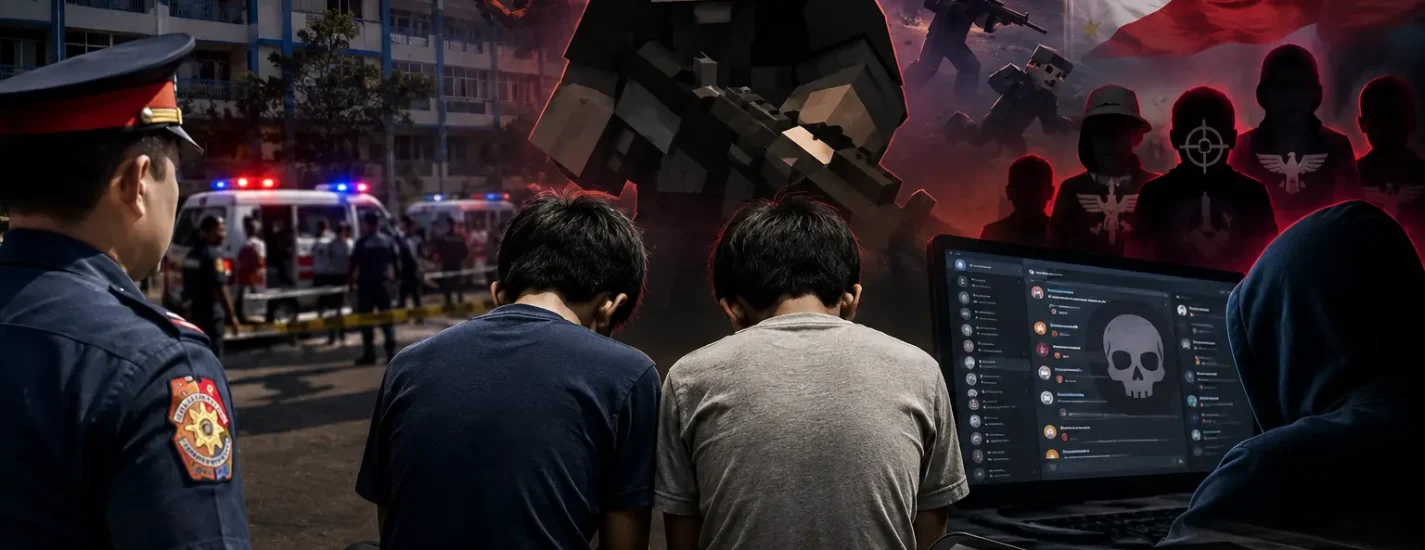

The Philippine National Police (PNP) has officially thrown its support behind a sweeping government review of violent video games following a fatal shooting incident at San Jose National High School in Tacloban City. PNP Chief Gen. Jose Melencio Nartatez Jr. expressed deep concern over the potential for copycat behavior among adolescents, noting that while youth violence is driven by multiple societal factors, the normalization of extreme digital violence cannot be ignored by law enforcement.
The tragic attack, which occurred on Monday, June 22, 2026, involved two students aged 14 and 15 who opened fire inside their campus. In the immediate aftermath, the Cybercrime Investigation and Coordinating Center (CICC) enacted a temporary ban on GoreBox after preliminary intelligence suggested both suspects were heavily exposed to the game’s hyper-violent mechanics leading up to the assault. Concurrently, Interior and Local Government Secretary Jonvic Remulla has pressed for a permanent, nationwide prohibition on similar content to combat what he described as the systematic desensitization of Filipino youth.
Tech Developers and Lawmakers Clash Over Accountability
Responding to the sudden regulatory pressure, German game developer Felix Filip of F2 Games issued a statement pledging full cooperation with Philippine authorities. However, the studio emphasized that GoreBox was explicitly built for adult audiences and carries an active 18+ maturity rating on global distribution platforms.
The regulatory backlash has drawn fierce criticism from the local gaming community, who argue that a blanket ban is a blunt, reactionary policy response. Millions of Filipinos have grown up playing mature titles like Counter-Strike and Grand Theft Auto without school shootings becoming a recurring phenomenon. For the latest breaking news updates and deep-dive cultural analysis on this developing story, readers can follow the main portal on our media network.
Strict Rehabilitation and Juvenile Justice Enforcement
Meanwhile, the Department of Social Welfare and Development (DSWD) Field Office 8 has assured the public that both minor suspects are being held under maximum restrictions without any special treatment. DSWD-8 Director Grace Subong confirmed that the duo is currently isolated at the Regional Rehabilitation Center for the Youth (RRCY) in Tanauan, Leyte.
The legal paths for the two boys will diverge significantly under the Juvenile Justice and Welfare Act (RA 9344). The 15-year-old suspect, alias “Rod,” faces formal inquest proceedings for three counts of murder, three counts of frustrated murder, and serious physical injury. The 14-year-old, alias “Nash,” is legally exempt from criminal liability due to his age but has been committed to a long-term, multi-year DSWD diversion program centered on socio-cultural and intensive psychological intervention. Director Subong detailed the strict nature of their confinement:
“With these restrictions, there is somehow a penalty and accountability as a result of their action. They are strictly banned from using phones, accessing the internet, watching television, and regularly talking to their families. In the event that the rehabilitation will fail, they will be referred to a regular jail facility when they reach the legal age.”
The Real Threat: Extremist Grooming in Digital Spaces
As the Senate prepares to convene hearings next week, technology analysts and digital extremism researchers urge lawmakers not to fall into the trap of blaming software alone. Data compiled by organizations like the Global Network on Extremist and Technology (GNET) reveals a much darker pattern: extremist grooming networks are actively utilizing the unmonitored multiplayer spaces, user-generated content (UGC) loops, and adjacent Discord servers of popular games to manipulate vulnerable minors.
Similar radicalization patterns have been flagged globally, including an incident in Singapore where a 14-year-old used GoreBox and Roblox to simulate terror attacks, and another in Moscow involving a 15-year-old textually tracking extremist blueprints. Experts note that even non-violent platforms like Minecraft have been co-opted by malign actors. GNET’s meta-analysis heavily emphasizes looking beyond the screen:
“In light of meta-analyses that do not appear to support substantive long-term links between aggressive game content and youth aggression, we should view the crucial digital element of this attack’s context through the attacker’s behaviours in the group chat and his use of the gaming space, rather than attaching them to the game itself.”
If lawmakers conclude these upcoming hearings under the impression that banning a single violent video game solves the crisis, they will have merely attacked a visible symptom. The much harder, more critical challenge moving forward is auditing how sophisticated international extremist networks are reaching Filipino children online, and fixing the systemic institutional gaps that failed to detect them before shots were fired.